Skull Base Surgery
When you hear the term skull base injury it might sound very complex and honestly it is one of the most delicate areas in neurosurgery. The skull base is the area at the bottom of your brain where important nerves and blood vessels pass through. Even a small issue in the region can affect your vision and hearing balance. If you have been advised skull base surgery by your neurosurgeon in Surat, it’s natural for you to feel anxious. You might have questions or even fear about what lies ahead. But here is what you should know: today’s medical advancements have made skull base surgery more precise and often less invasive than before. With the right expertise and approach many conditions can be treated effectively.
Our practice is a regional leader in skull base surgery, treating pituitary sellar and suprasellar tumors, complex CSF leaks, and various skull base lesions. Because this area is so delicate and deeply placed, treatment needs much more than routine neurosurgical skill. It requires detailed anatomical understanding, advanced planning, and surgical precision at every step.
Where Advanced Technology Meets Surgical Precision
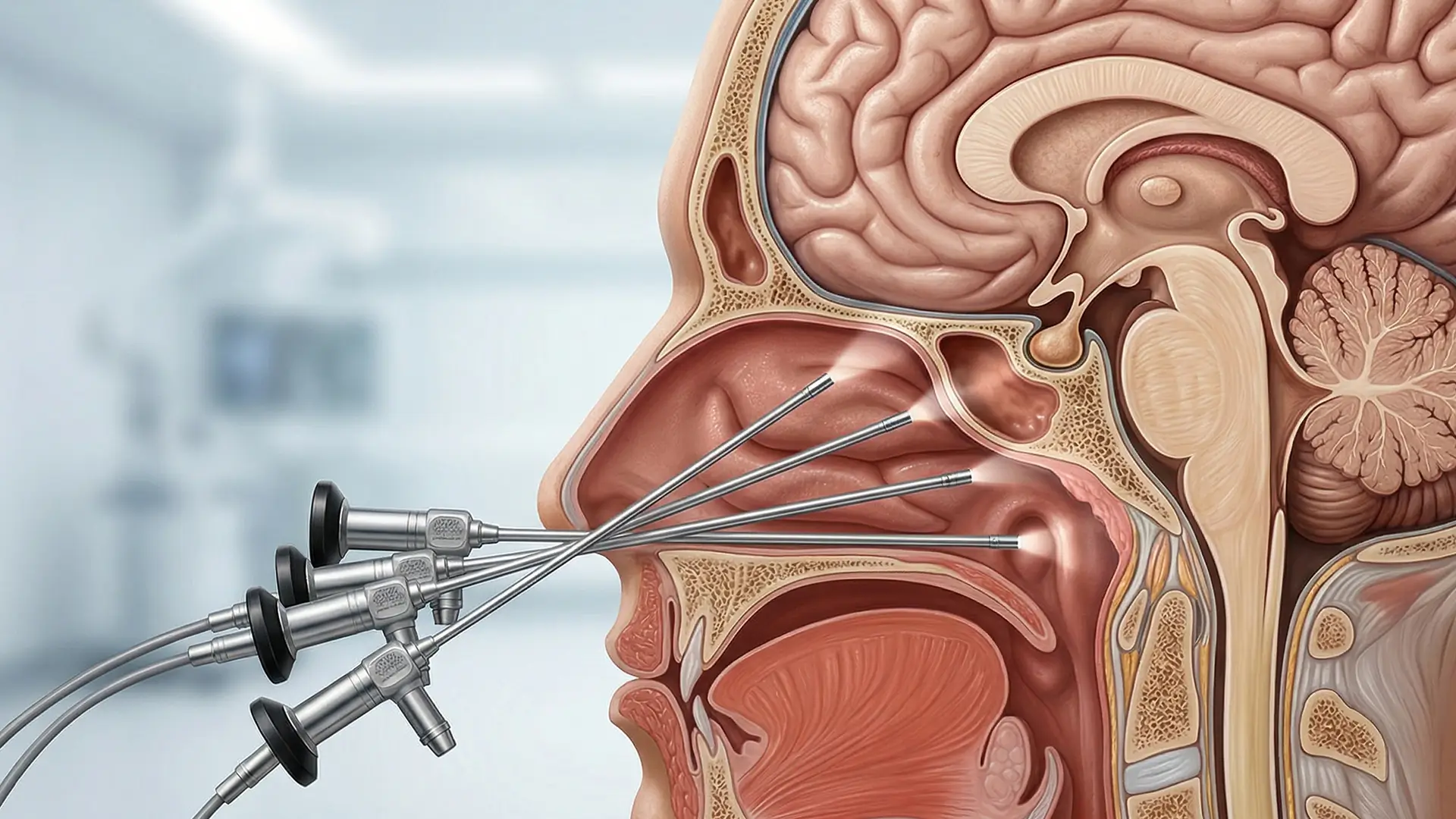
Skull base surgery requires a very high level of accuracy. This area is surrounded by critical structures so every step must be carefully planned. We use advanced tools like high definition imaging, neuro navigation systems, and endoscopic techniques to access and treat conditions with minimal disruption to your surrounding tissues. In many cases surgery can be performed through the nose, avoiding large external incisions. But beyond technology what truly matters is how we care for you. As one of the best brain doctors in Surat, we focus on clear communication and detailed planning.
The Hybrid Advantage: Microscope + Endoscope
We have moved beyond the limitation of choosing one technology over the other. By integrating both the microscope and the endoscope, we create a more advanced and safer surgical workflow.
Microscopic Trans-Sphenoidal Approach
We use the operating microscope to maintain the gold standard of binocular vision and true depth perception. This also gives the surgeon the freedom of two-handed surgical manipulation, which is especially important for the safe and deliberate removal of firm or complex tumors.
Endoscopic Augmentation
When the anatomy extends into deep or hidden corners, where even the best microscope has limitations, we seamlessly transition to the endoscope. This gives us around-the-corner visualization and helps ensure that no residual tumor is left behind and no nearby critical structure is compromised.
This hybrid methodology allows us to combine the stability and bimanual control of the microscope with the advanced optics and reach of the endoscope. It gives us a level of safety and completeness that single-technique approaches often cannot match.
What is Skull Base Surgery
Skull base surgery is a specialized procedure used to treat conditions located at the base of your brain, the underside of the skull, or nearby structures like the sinuses.
These conditions may include:
Tumors benign or malignant
Pituitary gland tumors
Acoustic neuromas affecting hearing and balance
Meningiomas
Vascular abnormalities
Cerebrospinal fluid CSF leaks
Infections or structural abnormalities
When do you need Skull Base Surgery?
Surgery is usually recommended when the condition cannot be managed with medication or other non-surgical treatments.
You may need skull base surgery if:
A tumor is growing or causing symptoms
You are experiencing vision or hearing problems
There is pressure on nerves or the brain
You have persistent headaches or neurological symptoms
There is a CSF leak or structural issue
What happens before Surgery?
We understand that preparing for surgery can feel overwhelming. That’s the only reason why we focus on making the process as easy and reassuring as possible.
Before surgery, you will go through:
A detailed consultation with a neurosurgeon in South Gujarat and medical history review
Imaging tests such as MRI or CT scans
Advanced planning using specialized software
Evaluation by a multidisciplinary team if needed
A clear discussion about the procedure, risks, and expected outcomes
Types of Skull Base Surgery
Endoscopic skull base surgery is a minimally invasive technique where surgery is performed by a brain surgery specialist in Surat using a thin camera through your nose. It is commonly used for pituitary tumors and certain skull base tumors. Open skull base surgery is a traditional open approach. It might be needed to access deeper or more complex areas. This allows the surgeon to directly reach and treat the condition safely.
Unprecedented Outcomes with Hybrid Technique
Our commitment to this hybrid technique has yielded outcomes that set a high benchmark in skull base neurosurgery. In our pituitary surgery series, we have achieved zero complications and zero recurrences to date.
This is a direct result of our hybrid methodology. By combining the microscope and the endoscope in a complementary way, we are able to perform surgery with more safety, better visualization, and greater thoroughness.
What is the Surgery Process like?
It’s normal for you to feel nervous before the surgery but knowing what to expect can truly make things easier for you. You will first be admitted and gently prepared for the procedure by the medical team. Most surgeries are done under general anesthesia so you will be asleep and won’t feel anything during the process.
Moving Forward with Confidence
Skull base conditions can actually feel complex and challenging but with the right expertise they can be treated effectively. If you have been advised surgery or you’re experiencing symptoms that need evaluation don’t delay. Connect with the best skull base surgery specialist in Gujarat.
Is skull base surgery safe?
Yes, with modern techniques and experienced surgeons it is much safer than before.
Will there be visible scars?
In many cases, especially with endoscopic surgery, there are no external scars.
How long does the surgery take?
It all depends on the complexity of your case. It can range from a few hours to longer procedures.
How long does the recovery take?
Recovery varies, but you can start feeling better within a few weeks. Full recovery might take longer depending on the condition.